/ May 08, 2026
Trending

What is a hotel? Is it a place to seek sanctuary, renewal, a place to create a lifelong memories and – here the strings reach a crescendo – a place to experience the true, deep connection that is hospitality?
Or is all the world a balance sheet and all the men and women just entries? Could the hotel sector really be little more than a distribution factory? A storage space with lockers to be filled with paying bodies, acquired as cheaply as possible and charged as much as they can stand, depending on the proximity of Taylor Swift, Oasis or – as our man in Singapore observed two weeks ago – the F1 Grand Prix?
 [Photos by Piers Lee, MD BDRC Asia]
Of course, as with so much in life, it’s a little of column A and a little of column B. And at the heart of the strategy is the brand, that logo over the door selling the guest a message about the welcome they’ll find within, telling them what to expect, and, fingers crossed, aligning with their hopes and dreams to the extent that they will forsake all others and only darken these doors from now on.
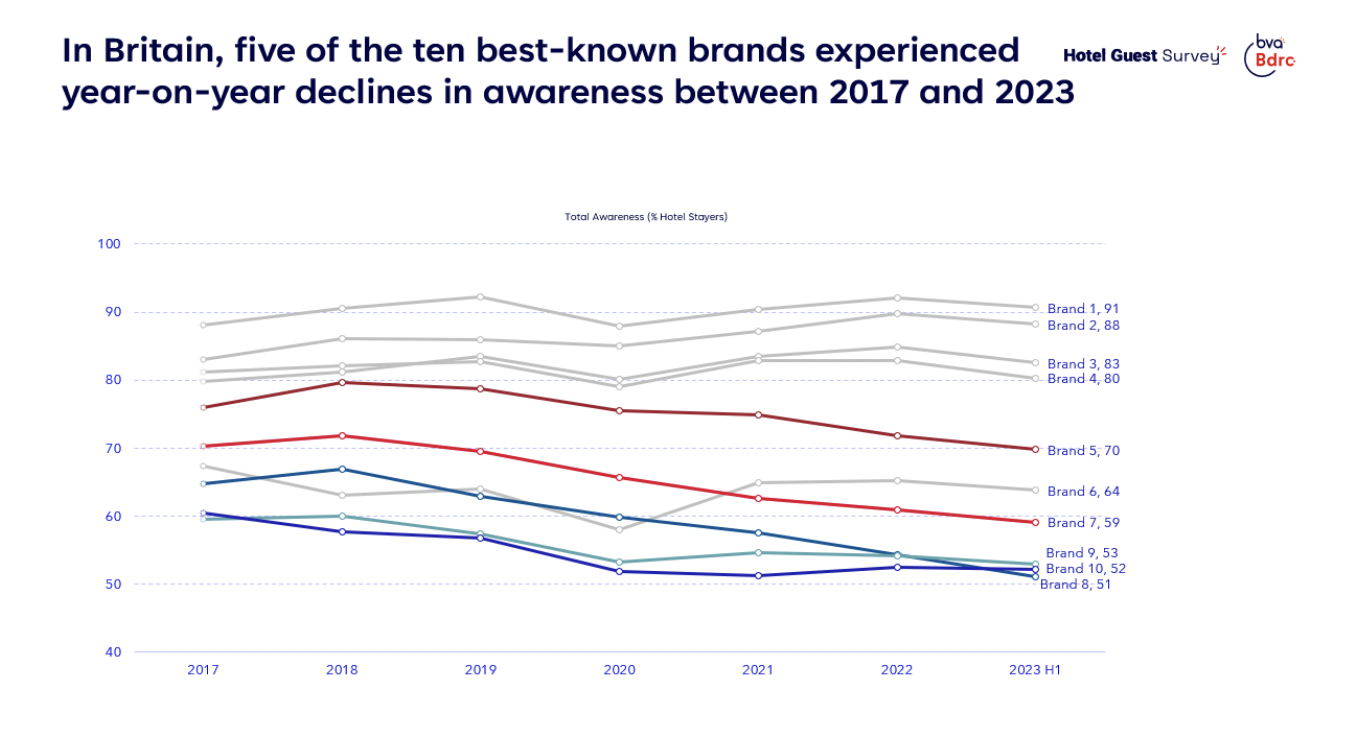
But our Hotel Guest Survey has found that, in Great Britain, five of the 10 best-known hotel brands experienced year-on-year declines in awareness between 2017 and 2023.
 [Source: BDRC Hotel Guest Survey – Great Britain 2023]
As a general rule, younger travellers have lower levels of awareness of individual brands, sliding down from Baby Boomers who reported 64% brand awareness, to Generation Z with 43%. This is not an equal trauma for the brands; in one case Gen Z had 90% awareness and the Baby Boomers 91%. But in another, Gen Z was as low as 19% to the Baby Boomers’ 73% and it is the brands with the largest gaps who are the ones seeing the largest declines as Gen Z becomes an increasing slice of the hotel-staying pie. 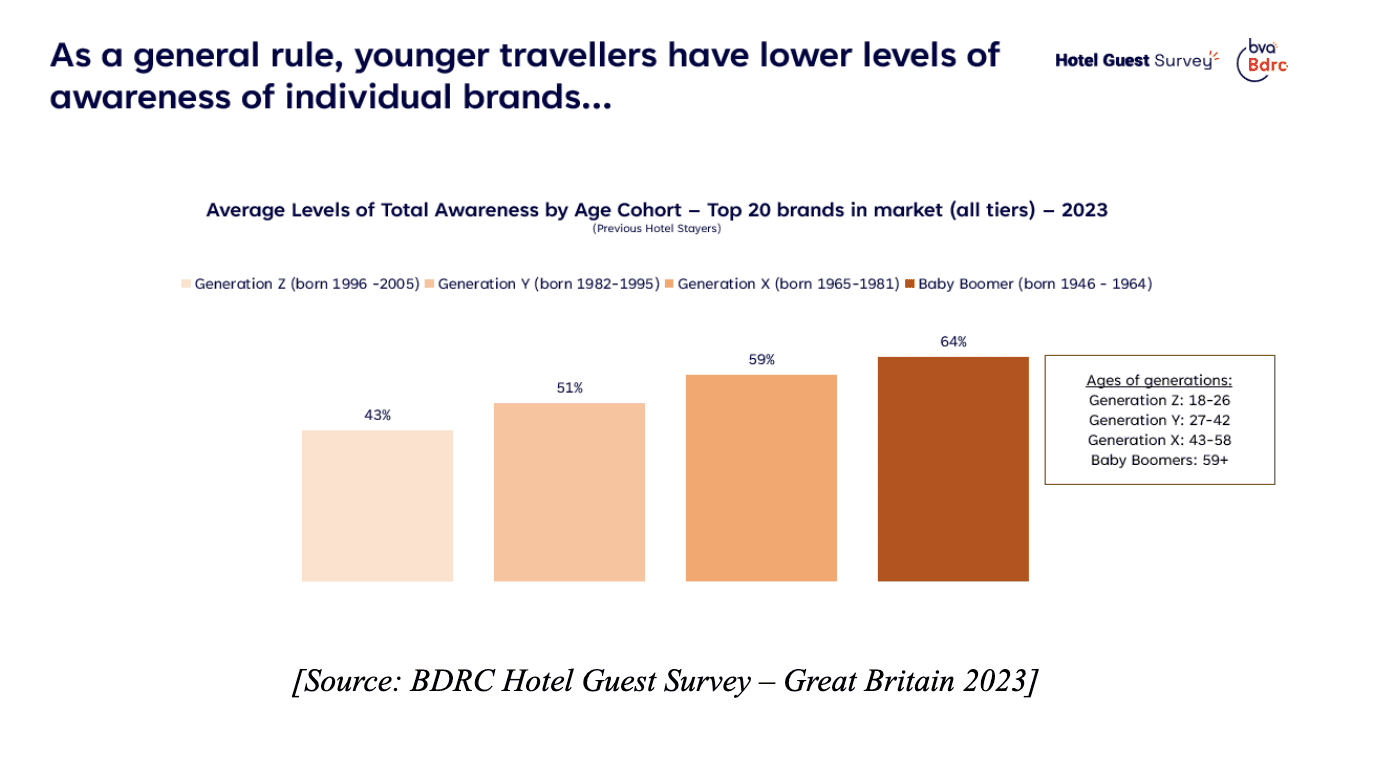 Why do younger travellers have lower awareness? It’s actually not a new phenomenon, but it seems to be a stronger, longer trend than it once was. I think it’s partly to do with broader choice. Imagine the difference in options available to a 20 year-old as they ‘enter’ the hotel market in 1995 and those available to one entering in 2025. But add onto this the OTA booking channels and alternatives such as Airbnb that just weren’t there 30 years ago and it’s a lot for even the broadest of brand shoulders to take on board.
Those alternative options have been successful in making their case to travellers, with 54% of leisure travellers preferring ‘other’ booking sites to direct hotel channels and only 30% of Brits considering the best rates to be available via direct hotel sites.
If you’re not careful, you can potentially go for years and years without even encountering a hotel brand that would have been as familiar to your mid-90s counterparts as compact discs, the six o’clock news and the Argos catalogue.
But does brand awareness matter anymore? If I can put my hotel in front of millions of buyers by simply agreeing to pay (gasps and holds nose) up to 20% in commission, what’s the point of branding it?
If you’re KitKat, it matters. Other chocolate bars (chunky or otherwise) are waiting at the corner shop to steal your crown and start dominating break times. Have a break, have a… a…Twix?
The red text inside the white oval upon the red background are so recognisable, so familiar that the tiny image of the wafer finger snapping in half – the actual product itself – is essentially redundant. You see the logo… you want the snack. No need to waste time or energy on something so irritating or tiring as thinking about, or comparing, your snacking options.
But what if you fancy something minty? Or orangey? Or salted-caramelly? Or chunky? No need to panic. No need to gamble on something new. There’s a KitKat for everyone…
…unless you don’t really like a KitKat
…in which case Nestle can offer you an Aero, or a Toffee Crisp, or a Yorkie (unless you’re a girl – IYKYK)
I doubt anyone stands up at confectionery conferences and asks Nestle if they feel they have too many brands, so why oh why does this question continue to be posed at hotel conferences?
It matters not one iota to Accor if you stay in a Novotel instead of a Mercure. Or a Tribe instead of an ibis styles. They don’t need anybody to know every brand, they just need everybody to know any brand.
The key is realising that the overall objective here is not the brand itself, but the brand family. And, to be clear, this is not the kind of family where Great Uncle Sébastien can remember the names of all the grandchildren. He doesn’t need to as long as he pats their heads and lets them know he’s proud they’re continuing his legacy.
The brand family is what feeds into the loyalty* programme and the loyalty programme, with its millions of members, is what attracts owners and what feeds hotel operators’ growth pipelines. One Accor brand out of <insert today’s number here> is enough to bring you into the loyalty system and from there, keeping you is an ALL-together different ball game.
What does this mean? Is awareness pointless?
Yes.
But at the same time…
…No.
Don’t get me wrong, awareness is still important. It has to be. It’s the figurative key to the literal door. Without awareness how can someone book your hotel? But awareness no longer takes time to gain or build at a micro level; an individual can become aware of your brand and then book it within seconds.
What the sector needs to focus on is not awareness for the sake of it, but instead the right type of awareness and the “convert-ability” of that awareness into consideration (good) or preference (better) – but not avoidance (bad).
In the Hotel Guest Survey, the conversion ratios are as interesting as the raw brand health metrics. And, for me, conversion is the crucial indicator of brand potential. Small brands that convert effectively become prime candidates for successful expansion. Large brands that convert negatively really need to be overhauled – without, of course, throwing the baby out with the bathwater.
We keep on (and will keep on) getting more brands simply because the two fundamental forces of economics, supply and demand, push us to have more brands.
Until those things change (they won’t), we’ll keep getting more brands.
What is a hotel? Is it a place to seek sanctuary, renewal, a place to create a lifelong memories and – here the strings reach a crescendo – a place to experience the true, deep connection that is hospitality?
Or is all the world a balance sheet and all the men and women just entries? Could the hotel sector really be little more than a distribution factory? A storage space with lockers to be filled with paying bodies, acquired as cheaply as possible and charged as much as they can stand, depending on the proximity of Taylor Swift, Oasis or – as our man in Singapore observed two weeks ago – the F1 Grand Prix?
[Photos by Piers Lee, MD BDRC Asia]
Of course, as with so much in life, it’s a little of column A and a little of column B. And at the heart of the strategy is the brand, that logo over the door selling the guest a message about the welcome they’ll find within, telling them what to expect, and, fingers crossed, aligning with their hopes and dreams to the extent that they will forsake all others and only darken these doors from now on.
But our Hotel Guest Survey has found that, in Great Britain, five of the 10 best-known hotel brands experienced year-on-year declines in awareness between 2017 and 2023.
[Source: BDRC Hotel Guest Survey – Great Britain 2023]
As a general rule, younger travellers have lower levels of awareness of individual brands, sliding down from Baby Boomers who reported 64% brand awareness, to Generation Z with 43%. This is not an equal trauma for the brands; in one case Gen Z had 90% awareness and the Baby Boomers 91%. But in another, Gen Z was as low as 19% to the Baby Boomers’ 73% and it is the brands with the largest gaps who are the ones seeing the largest declines as Gen Z becomes an increasing slice of the hotel-staying pie. Why do younger travellers have lower awareness? It’s actually not a new phenomenon, but it seems to be a stronger, longer trend than it once was. I think it’s partly to do with broader choice. Imagine the difference in options available to a 20 year-old as they ‘enter’ the hotel market in 1995 and those available to one entering in 2025. But add onto this the OTA booking channels and alternatives such as Airbnb that just weren’t there 30 years ago and it’s a lot for even the broadest of brand shoulders to take on board.
Those alternative options have been successful in making their case to travellers, with 54% of leisure travellers preferring ‘other’ booking sites to direct hotel channels and only 30% of Brits considering the best rates to be available via direct hotel sites.
If you’re not careful, you can potentially go for years and years without even encountering a hotel brand that would have been as familiar to your mid-90s counterparts as compact discs, the six o’clock news and the Argos catalogue.
But does brand awareness matter anymore? If I can put my hotel in front of millions of buyers by simply agreeing to pay (gasps and holds nose) up to 20% in commission, what’s the point of branding it?
If you’re KitKat, it matters. Other chocolate bars (chunky or otherwise) are waiting at the corner shop to steal your crown and start dominating break times. Have a break, have a… a…Twix?
The red text inside the white oval upon the red background are so recognisable, so familiar that the tiny image of the wafer finger snapping in half – the actual product itself – is essentially redundant. You see the logo… you want the snack. No need to waste time or energy on something so irritating or tiring as thinking about, or comparing, your snacking options.
But what if you fancy something minty? Or orangey? Or salted-caramelly? Or chunky? No need to panic. No need to gamble on something new. There’s a KitKat for everyone…
…unless you don’t really like a KitKat
…in which case Nestle can offer you an Aero, or a Toffee Crisp, or a Yorkie (unless you’re a girl – IYKYK)
I doubt anyone stands up at confectionery conferences and asks Nestle if they feel they have too many brands, so why oh why does this question continue to be posed at hotel conferences?
It matters not one iota to Accor if you stay in a Novotel instead of a Mercure. Or a Tribe instead of an ibis styles. They don’t need anybody to know every brand, they just need everybody to know any brand.
The key is realising that the overall objective here is not the brand itself, but the brand family. And, to be clear, this is not the kind of family where Great Uncle Sébastien can remember the names of all the grandchildren. He doesn’t need to as long as he pats their heads and lets them know he’s proud they’re continuing his legacy.
The brand family is what feeds into the loyalty* programme and the loyalty programme, with its millions of members, is what attracts owners and what feeds hotel operators’ growth pipelines. One Accor brand out of <insert today’s number here> is enough to bring you into the loyalty system and from there, keeping you is an ALL-together different ball game.
What does this mean? Is awareness pointless?
Yes.
But at the same time…
…No.
Don’t get me wrong, awareness is still important. It has to be. It’s the figurative key to the literal door. Without awareness how can someone book your hotel? But awareness no longer takes time to gain or build at a micro level; an individual can become aware of your brand and then book it within seconds.
What the sector needs to focus on is not awareness for the sake of it, but instead the right type of awareness and the “convert-ability” of that awareness into consideration (good) or preference (better) – but not avoidance (bad).
In the Hotel Guest Survey, the conversion ratios are as interesting as the raw brand health metrics. And, for me, conversion is the crucial indicator of brand potential. Small brands that convert effectively become prime candidates for successful expansion. Large brands that convert negatively really need to be overhauled – without, of course, throwing the baby out with the bathwater.
We keep on (and will keep on) getting more brands simply because the two fundamental forces of economics, supply and demand, push us to have more brands.
Until those things change (they won’t), we’ll keep getting more brands.