/ May 13, 2026
Trending

World Cup 2026 Poses Hotel Room Crunch Across Host Cities
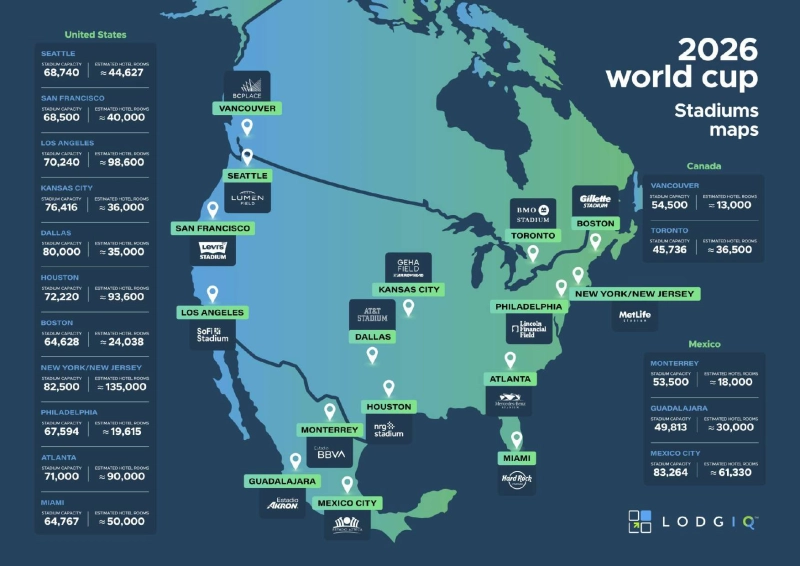
The 2026 FIFA World Cup will rotate 16 host venues across the United States, Canada and Mexico. An infographic produced by 10 Minutes Hotels in partnership with LodgIQ overlays each stadium’s seating capacity with the estimated local hotel-room inventory. The visual makes one reality clear: some host cities have far fewer rooms than the stadium can accommodate.
Examples from the dataset include:
| Host | Stadium Capacity | Estimated Hotel Rooms |
|---|---|---|
| Vancouver (BC Place) | 54,500 | ≈ 13,000 |
| Kansas City (GEHA Field) | 76,416 | ≈ 36,000 |
| New York / New Jersey (MetLife) | 82,500 | ≈ 135,000 |
| Los Angeles (SoFi) | 70,240 | ≈ 98,600 |
| Mexico City (Estadio Azteca) | 83,264 | ≈ 61,330 |
| Monterrey | 53,500 | ≈ 18,000 |
Why this matters: In cities like Vancouver, where stadium seating far outstrips room supply, single-night and multi-night compression will be extreme. Expect sharp ADR spikes, limited availability for groups, and outbound spillover into surrounding regions. Revenue management implications
Revenue teams should treat the tournament window as a multi-faceted yield event, not a single headline night. Practical implications include:
Operational and distribution considerations Staffing & labor:
Surge staffing plans, cross-training, and temporary labor pools will be essential in high-compression markets. Start recruitment and scheduling scenarios now to avoid last-minute shortages.
Transportation & logistics:
Where primary cities lack rooms, expect spillover to suburbs and neighboring cities. Coordinate with local authorities and transport partners to ensure smooth guest movement.
Ancillary revenue:
With rooms scarce, optimize F&B, premium parking, late-checkout fees, and packaged experiences to capture incremental spend from high-value visitors.
Reputation & guest experience:
High ADRs create higher guest expectations. Maintain service standards — poor experiences during this flagship event can have long-lasting brand consequences.
Market strategy: think regionally
Not every host city will be able to accommodate every fan. Operators in adjacent markets — regional airports, suburban markets and neighboring towns — should prepare capture strategies for diverted demand: targeted marketing, packaged transportation, and partner distribution deals (shuttle + room) can convert overflow into revenue.
Next steps for hoteliers
The 2026 World Cup is a once-in-a-generation demand event. The infographic from 10 Minutes Hotels and LodgIQ is a useful decision-support tool: its city-by-city view surfaces where supply shortages will be most acute and where hotels — and their revenue managers — will need to be most strategic. With advance planning, the tournament can be a major revenue opportunity and a chance to showcase service excellence to a global audience.
World Cup 2026 Poses Hotel Room Crunch Across Host Cities
The 2026 FIFA World Cup will rotate 16 host venues across the United States, Canada and Mexico. An infographic produced by 10 Minutes Hotels in partnership with LodgIQ overlays each stadium’s seating capacity with the estimated local hotel-room inventory. The visual makes one reality clear: some host cities have far fewer rooms than the stadium can accommodate.
Examples from the dataset include:
| Host | Stadium Capacity | Estimated Hotel Rooms |
|---|---|---|
| Vancouver (BC Place) | 54,500 | ≈ 13,000 |
| Kansas City (GEHA Field) | 76,416 | ≈ 36,000 |
| New York / New Jersey (MetLife) | 82,500 | ≈ 135,000 |
| Los Angeles (SoFi) | 70,240 | ≈ 98,600 |
| Mexico City (Estadio Azteca) | 83,264 | ≈ 61,330 |
| Monterrey | 53,500 | ≈ 18,000 |
Why this matters: In cities like Vancouver, where stadium seating far outstrips room supply, single-night and multi-night compression will be extreme. Expect sharp ADR spikes, limited availability for groups, and outbound spillover into surrounding regions. Revenue management implications
Revenue teams should treat the tournament window as a multi-faceted yield event, not a single headline night. Practical implications include:
Operational and distribution considerations Staffing & labor:
Surge staffing plans, cross-training, and temporary labor pools will be essential in high-compression markets. Start recruitment and scheduling scenarios now to avoid last-minute shortages.
Transportation & logistics:
Where primary cities lack rooms, expect spillover to suburbs and neighboring cities. Coordinate with local authorities and transport partners to ensure smooth guest movement.
Ancillary revenue:
With rooms scarce, optimize F&B, premium parking, late-checkout fees, and packaged experiences to capture incremental spend from high-value visitors.
Reputation & guest experience:
High ADRs create higher guest expectations. Maintain service standards — poor experiences during this flagship event can have long-lasting brand consequences.
Market strategy: think regionally
Not every host city will be able to accommodate every fan. Operators in adjacent markets — regional airports, suburban markets and neighboring towns — should prepare capture strategies for diverted demand: targeted marketing, packaged transportation, and partner distribution deals (shuttle + room) can convert overflow into revenue.
Next steps for hoteliers
The 2026 World Cup is a once-in-a-generation demand event. The infographic from 10 Minutes Hotels and LodgIQ is a useful decision-support tool: its city-by-city view surfaces where supply shortages will be most acute and where hotels — and their revenue managers — will need to be most strategic. With advance planning, the tournament can be a major revenue opportunity and a chance to showcase service excellence to a global audience.